
What Joy Actually Is
And Why I think 'Happy' Is Overrated

We use these words interchangeably, most of us. Joy. Happiness. As though they’re simply different intensities of the same thing—happiness on a good day, joy on a great one.
I wholeheartedly disagree with considering these words synonyms.
Conflating them is costing us something and I think it’s worth dismantling them a bit. Can we look at what’s underneath, and figure out which one we’re actually chasing? And whether the thing we’re chasing is even capable of being caught…
Yes, fine. I have issues with happiness
Happiness, as most of us have been taught to pursue it, is circumstance-dependent.
It arrives when things go right. When the relationship works, when the job comes through, when the number on the scale cooperates, when the holiday actually delivers on its promise. It is, fundamentally, a response. Something that happens TO you when the conditions are favorable.
Which means the entire project of pursuing happiness is really a project of controlling circumstances. Of arranging your external world carefully enough that the feeling you’re hoping for finally shows up and stays.
That project (and process) doesn’t end. It can’t. Because circumstances are, by their nature, unreliable. They shift. They disappoint. They cooperate beautifully for a while and then stop cooperating entirely, usually at the most inconvenient moment.
Psychologists have a name for the particular trap this creates. They call it the arrival fallacy. This is the belief that once you reach a certain destination, once you achieve the thing or acquire the thing or become the thing, the feeling of fulfilment will finally be permanent. Except it never is. You arrive, you feel it briefly, and then the goalposts rearrange themselves and the whole pursuit begins again.
I’m not about to label this a character flaw. It’s definitely not ingratitude or restlessness or an inability to be satisfied. It could be that this is what happens when you’ve built your sense of wellbeing on a foundation that was never designed to hold the weight you’ve placed on it.
Happiness is real. It’s wonderful when it shows up. And also, it can never be a permanent address.
My love affair with joy, explored
Joy is something different in kind, not just degree.
Henry Miller is, in my opinion, one of the most joyfully, almost recklessly alive writers who ever put pen to paper. He spent much of his life and work circling this distinction.
He wrote, “The aim of life is to live, and to live means to be aware, joyously, drunkenly, serenely, divinely aware.”
Read that again slowly, let these words do their work.
He doesn’t say the aim of life is to be happy. He doesn’t mention circumstances at all. Instead, he talks about awareness. About the quality of attention you bring to your own existence. Joyously, drunkenly, serenely, divinely—four completely different emotional temperatures, and he’s saying joy is available across all of them.
That’s the distinction I want you to feel, not just intellectually understand.
Happiness is a response to what’s happening. Joy is a relationship with being alive. And those are not the same thing. Not even close.
Joy doesn’t require the wind to blow just right. It doesn’t wait for the relationship to be fixed or the business to take off or the difficult season to pass. It is available, right now, in this moment, in whatever shape this moment is taking, to anyone willing to turn their attention toward it.
Which brings us to another of Miller’s insights, "The moment one gives in to joy, one is free.”
Gives IN to it. Not earns it, not achieves it, not arrives at it after sufficient suffering or striving. Gives in. As though joy is already present and the only thing standing between you and it is your own resistance. Your insistence on waiting until the conditions are right. Your insidious beliefs that you haven’t quite earned it yet.
But what if you have? What if you already have?
Awareness Has the Power to Change Everything
I love simplicity. I may be habitually drawn to abstract thoughts, but I still want actionable steps to apply in my everyday life. If you are reading this and thinking, “this resonates but I have no idea what to actually DO with it”—here’s more Miller. This might be my favorite thing he ever put down on paper. I’ve written it on countless post-it notes and 3x5 cards that are strewn around my house.
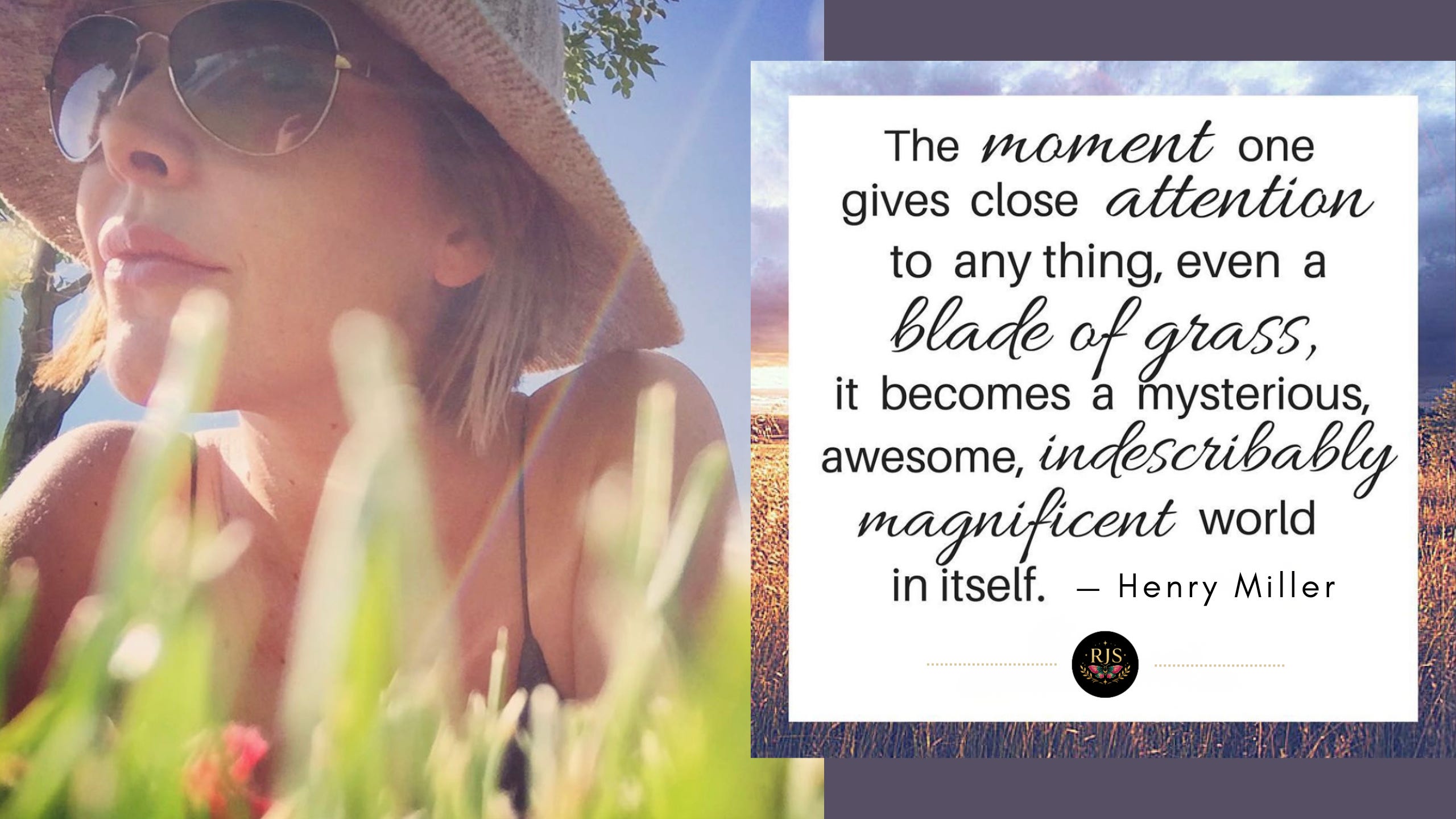
“The moment one gives close attention to anything, even a blade of grass, it becomes a mysterious, awesome, indescribably magnificent world in itself.”
A blade of grass.
Not a sunset over the Amalfi coast. Not a transcendental meditation experience. Not a pivotal life moment you’ll remember forever. A blade of grass—ordinary, unremarkable, everywhere—becomes indescribably magnificent the moment you give it your full, undivided attention.
This is not poetic hyperbole. This is a practical instruction.
Joy lives in the quality of your attention. It is not a feeling that descends on you from the outside; it is what happens when you are genuinely, fully, presently HERE. When you stop running the mental commentary about what you should be doing or what happened yesterday or what might go wrong tomorrow, and you simply notice what is actually in front of you.
The warmth of a mug in your hands. The particular quality of light on a winter afternoon. The sound of a voice you love. The satisfying weight of a book you haven’t opened yet.
These things are always there. The joy they’re capable of producing is always there. What varies is where your attention is placed.
This is why I think of joy as a practice rather than a destination. Not something you arrive at, but something you cultivate, deliberately and repeatedly, through the conscious direction of your awareness. Some days the practice comes easily. Some days it takes everything you have just to notice one blade of grass and mean it.
Both of those days count. Both of them are the practice.

Choosing joy—really choosing it, as a practice, as a relationship with being alive rather than a response to favorable circumstances—is one of the most quietly rebellious things you can do in a world that is constantly, aggressively trying to convince you that you don’t have enough, aren’t enough, haven’t achieved enough to feel good yet.
The entire architecture of modern consumer culture is built on the premise that happiness is just one more purchase away. One more achievement. One more upgrade. It needs you to believe that the feeling you’re looking for is external, acquirable, and perpetually just out of reach.
Joy, as Miller understood it, as I’ve come to understand it, pulls the rug out from under that entire mechanism. Because if joy is available in the most mundane aspects of nature, the ones we are so quick to ignore, if it lives in the quality of your attention rather than the content of your circumstances, then no one can sell it to you. No one can withhold it from you. No one can tell you you haven’t earned it yet.
It was always yours. You just have to give in to it. And apparently, the moment you do, you’re free.