

A More Beautiful Question
When "Is this really it?" becomes the beginning instead of the end.

There’s a question that circulates every so often in life.
Never during a crisis. Not at rock bottom. It shows up on an ordinary Tuesday, usually. While you’re loading the dishwasher, or sitting in traffic, or scrolling through something you don’t even care about. It arrives without fanfare and it doesn’t shout. It just... lingers.
Is this really it?
And then, almost immediately, the internal PR machine kicks in. You remind yourself of everything you have. You run the gratitude checklist. You tell yourself that other people have it so much harder, that you’re being dramatic, that you should just get on with it.
And you do. You get on with it.
But the question doesn’t leave. It just goes quiet for a while.
Is it taboo to talk about that question? Naturally, I can’t answer it for you, but we can give it some air. Right? I think a lot of us are carrying it around in silence, vaguely ashamed of it, not quite knowing what to do with it.
But silence can make us feel isolated.
There’s an interesting thread that binds folks who find their way to spaces like this one.
They are not, by any external measure, failing. Most of them have built something solid: a career, a family, a life that looks (at least from the outside) entirely reasonable. Entirely fine. They followed the path. Not blindly, but earnestly. They did the things they were told would lead to the feeling of arrival, the sense that everything had finally clicked into place and they could exhale.
Yet… they’re still waiting to exhale.
The pay-off that was promised, the deep satisfaction, the sense of meaning, the feeling that this is what I’m here for hasn’t shown up. Or it showed up briefly and then quietly evaporated. Or it showed up in glimpses, in moments, but never as a permanent address.
So they keep going. Keep achieving, keep producing, keep ticking boxes. Because stopping feels dangerous and complaining feels ungrateful and admitting that something is missing feels like a betrayal of everything they’ve built.
I know this story. Maybe you do, too?
There’s a particular flavor of dissatisfaction that doesn’t have a proper name.
It’s not depression, though it can look adjacent to it from certain angles. It’s not burnout, though exhaustion is often part of it. It’s not a crisis, not really, because nothing has actually gone wrong.
It’s more like a low hum. A background frequency. A restlessness that lives just underneath the surface of an otherwise functional life.
And here’s what I want you to hear, clearly and without qualification: that restlessness is not a flaw. It is not ingratitude. It is not weakness or selfishness or a sign that something is fundamentally broken in you.
It is your inner life asking to be taken seriously.
It is the part of you that knows—has always known—that you are capable of more than surviving. That you were not put here to simply produce and consume and manage and maintain until you run out of time.
That part of you is not wrong. That part of you is, quite possibly, the wisest part of you. It deserves to be listened to.
A lot of us grew up absorbing a very specific story about what a good life looks like.
Work hard. Be responsible. Be grateful. Don’t rock the boat. Follow the steps. Arrive at the destination.
And somewhere inside that story, the question of what YOU actually want, not what you’re supposed to want, not what makes sense on paper, but what genuinely lights something up inside you, got a bit lost.
We became very good at the life we were handed and some small part of us has been quietly grieving the life we might have chosen.
That grief is real. It’s worth acknowledging and it doesn’t mean anything about your life is wrong. It means you’re aware enough to feel the gap between where you are and where something deeper is calling you.
The consumer vs creator question is one that plagues me.
So much of modern life is structured around consumption. We consume content, we consume products, we consume other people’s stories and aesthetics and versions of success. Consumption isn’t inherently bad. I am a voracious consumer of books and ideas and other people’s perspectives and it brings me an inordinate amount of joy.
But there’s a difference between consuming intentionally, as fuel for your own becoming, and consuming as a way of avoiding the more uncomfortable question of what YOU are here to create.
The rat race is, at its core, a consumption loop. You work to earn, you earn to spend, you spend to feel something, and then you work harder to feel it again. And it’s not that any individual piece of that is wrong. It’s that the loop itself doesn’t have an exit ramp built in. Nobody is going to tap you on the shoulder and say “right, you’ve done enough consuming now, what would you like to actually build with your one wild and precious life?”
You have to notice the loop yourself. Then you have to decide, intentionally and on your own terms, whether you want to keep running it.
If you’re here, I suspect some part of you has already started noticing.
Maybe you can’t quite articulate what feels off. Maybe you’ve tried to explain it to someone you love and watched their eyes gloss over slightly because from where they’re standing everything looks absolutely fine. Maybe you’ve talked yourself out of it a hundred times and keep arriving back at the same low hum anyway.
That’s okay. You don’t need to have it figured out.
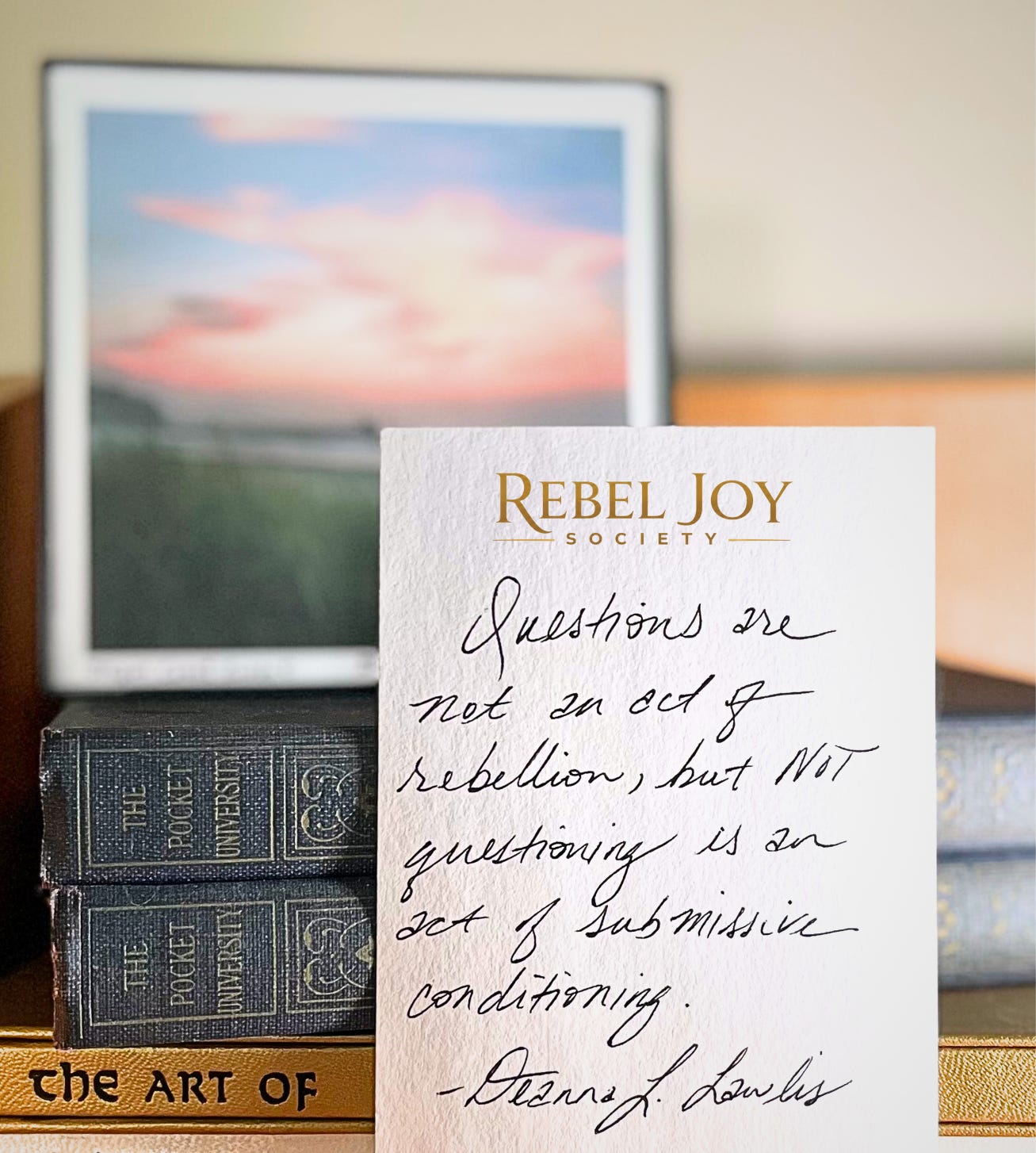
This space isn’t about having answers. It’s about being willing to sit with the questions, really sit with them, without rushing to resolve the discomfort they create. It’s about choosing curiosity over certainty, and community over the particular loneliness of carrying something unarticulated.
The question is this really it is not a problem to be solved.
It’s an invitation. Possibly even an initiation.
If you’re brand new here, The Rebel Joy Starter Kit is your first step. It’s $11 and it’s the distillation of everything I believe about joy as a practice—the perfect place to begin.