
A Map for What You Feel
(and a gentler way to understand the emotions you’ve been trying to outrun)

When was the last time you felt something you immediately wished you hadn’t? Anxiety before a difficult conversation. Jealousy you couldn’t quite justify. Grief that arrived uninvited on an otherwise ordinary afternoon. Anger that flared up faster than you could manage it.
And in the moment after feeling it—before you’d even had time to properly feel it—did you notice the secondary response? Judgment. The quiet internal verdict. The I shouldn’t be feeling this. The subtle but persistent message that whatever was moving through you was somehow wrong, excessive, a problem to be solved or suppressed or apologized for as quickly as possible.
Most of us were taught, in ways both explicit and entirely unspoken, that emotions exist on a vertical scale. Gratitude and love at the top. Fear and shame and grief at the bottom. And the goal, the whole project, is to stay as high up the scale as possible and scramble back up quickly whenever you slip.
It might sound reasonable. But don’t you think it’s exhausting? It seems we weigh and quantify everything. Even our own emotions. We either take them too seriously or we don’t take them seriously enough.
The Emotional Scale framework I want to share with you today comes from the teachings of Abraham Hicks. When applied it can be lifechanging! What I’m offering here is my own lens on it—the Rebel Joy translation, if you like.
The emotional scale, as I work with it, is laid out in two columns.
On the left: the expansive emotions. Joy, love, enthusiasm, freedom, appreciation, passion, optimism, hopefulness. These are the emotions that open something in us. They widen our perspective, increase our sense of possibility, make us feel more ourselves rather than less.
On the right: the constrictive emotions. Fear, grief, shame, anger, jealousy, overwhelm, hopelessness. These are the emotions that narrow something in us. They tighten our field of vision, pull us inward, make the world feel smaller and less navigable than it did five minutes ago.
Two columns. Side by side. Equal space on the page.
Side by side, with equal weight, these two sets of emotional descriptors stop looking like success and failure or good vs bad. They start looking like what they actually are.
Two halves of a complete human experience. No more, no less.
Here’s what most of us were never taught: constrictive emotions are not malfunctions.
They are not signs that something has gone wrong with you, or that you’re failing at the project of being a well-adjusted adult, or that you need to fix yourself before you’re allowed to feel good again. They are not punishments, and they are not permanent weather systems you’re powerless to influence.
They are signals.
Every single emotion on that right-hand column is your inner world communicating something specific and important. Anxiety is telling you that something you care about feels uncertain or under threat. Anger is telling you that a boundary has been crossed, a value violated, something important dismissed. Grief is telling you that you loved something real. Shame, one of the most painful and most misunderstood, is often telling you that you’ve absorbed someone else’s verdict about your worth and quietly started to believe it.
None of these are wrong. None of them need to be silenced or ignored or spiritually bypassed with excessive gratitude journaling.
They need to be listened to.
The constrictive emotions are not the opposite of joy. They are, in many cases, the doorway to it; they are pointing directly at the things that matter most to you. You cannot feel grief about something you didn’t love. You cannot feel angry about something you don’t value. The very intensity of a constrictive emotion is a measure of how alive and engaged you actually are.
That’s not a problem. That’s information.
When we think of emotions as a vertical ladder—with joy at the top and despair at the bottom—we create a particular kind of suffering that has nothing to do with the original emotion.
We feel anxious. And then we feel bad about feeling anxious. And then we feel anxious about feeling bad about feeling anxious. And suddenly we’re not dealing with the original signal at all, we’re three layers deep in a story about what our anxiety means about us as a person.
This is the vertical scale trap. It doesn’t just ask you to feel difficult emotions. It asks you to feel shame ON TOP of difficult emotions. It turns every uncomfortable feeling into evidence of a personal failing.
What happens when you lay the scale horizontal instead: two columns, side by side, neither one above the other?
You stop climbing and start listening. It can become a game of compare and contrast. Everything is better with a touch of whimsy.
The constrictive emotion is no longer something to escape as quickly as possible. It’s something to get curious about. What is this telling me? What does the intensity of this feeling reveal about what I care about? What would the equal and opposite expansive emotion look like right now, and what would need to shift for me to access it?
This is not toxic positivity. I am not suggesting you slap a gratitude practice on top of genuine pain and call it healing. Some emotions need to be fully felt before they can move. Grief may demand your devotion for a time. Anger often needs to be honored before it can be released.
What I’m suggesting is simply this—stop making the difficult emotion wrong. Stop adding the second layer of suffering on top of the first. Feel what you feel, with curiosity rather than judgment, and trust that your inner world is communicating something worth hearing.
Joy is not the absence of the right-hand column.
A joyful life is not a life without fear, grief, anger, or shame. It is not a life lived exclusively in the left column. That’s performance and it is absolutely exhausting to maintain.
A genuinely joyful life is one in which you have developed a relationship with the full spectrum of your emotional experience. Where you can feel the constrictive emotions without being capsized by them. Where you understand that the expansive emotions are not rewards for good behavior. They are always available, always present underneath the surface, accessible the moment you stop fighting what’s actually moving through you.
Like I shared in my last post, Henry Miller wrote that the moment you give in to joy, you are free. I think this is part of what he meant. Not the bypassing of difficulty. The willingness to feel everything—drunkenly, serenely, joyously, even painfully—and trust that none of it can actually destroy you.
The full spectrum is not the obstacle to joy. It IS the joy.
Let’s look at the emotional scale image below. Really look at it. Notice, there is no positive vs negative. No good vs bad.
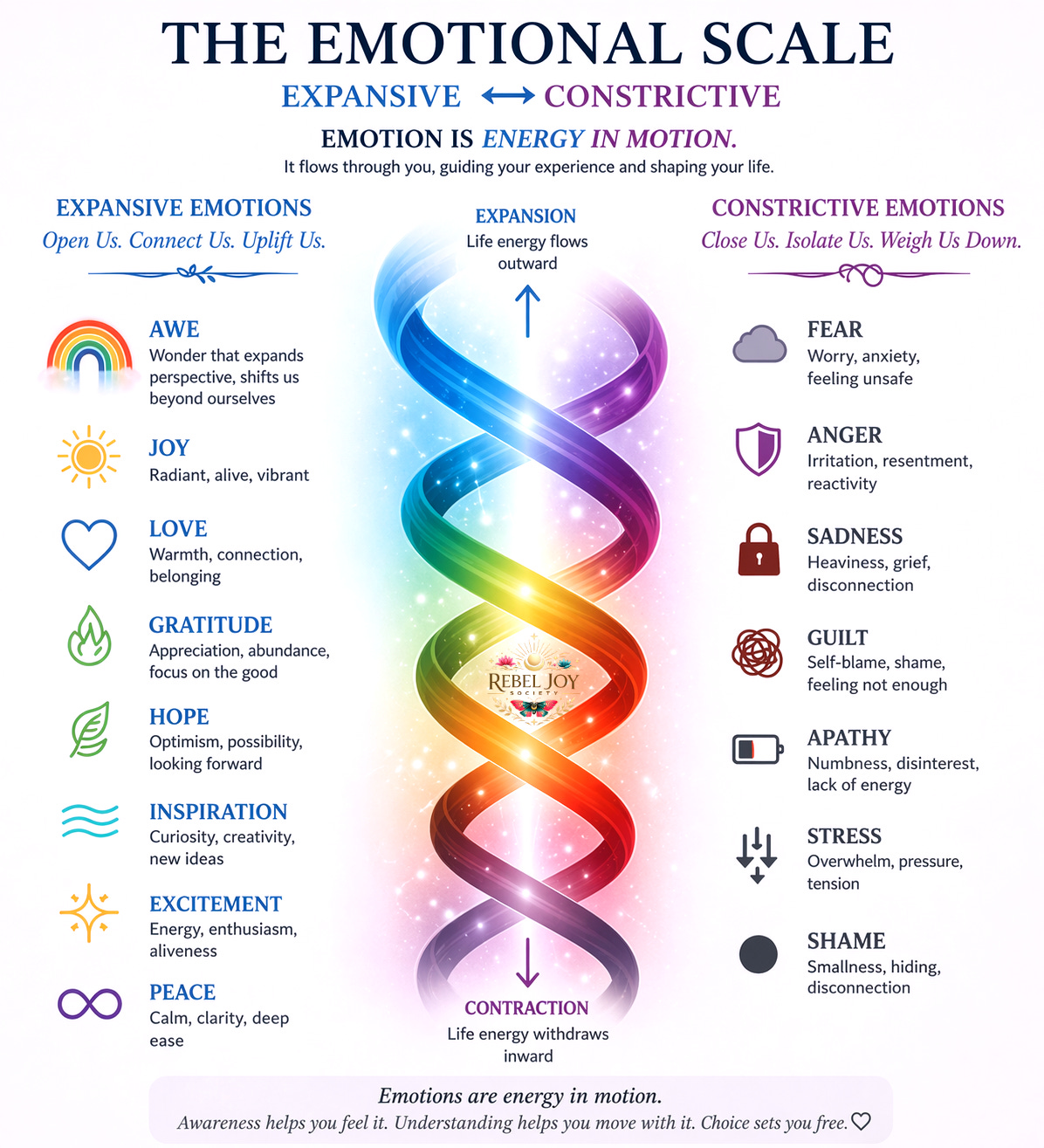
Find where you are today—honestly, without judgment. Left column or right, somewhere in the middle, oscillating between both depending on the hour.
Consider this: what is the constrictive emotion you’re currently feeling most trying to tell you? Not what does it mean about you. What is it pointing AT? What does it care about, on your behalf?
Sit with that for a few minutes. Write it down if you’re the writing type.
That’s the whole practice. That’s the beginning of a completely different relationship with your own inner world.
I go in-depth into the Emotional Scale in my Starter Kit. You can learn more below.

I hope your week is off to a beautiful start. ♥